
Pedestrian & bicycle accidents · Subcategory
Pedestrian Accident Lawyer in Texas
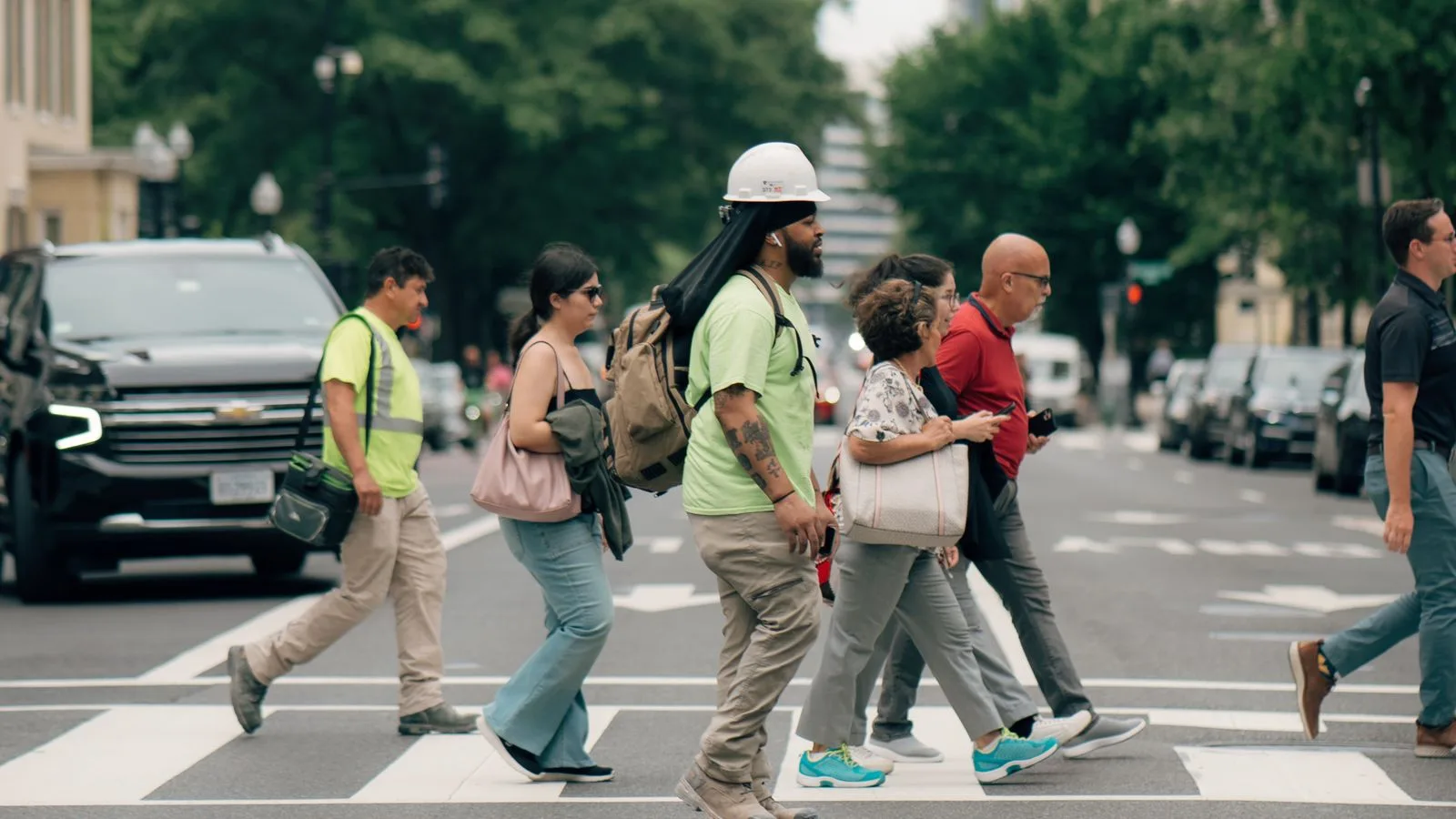
A Texas pedestrian accident case is a negligence claim brought by a person on foot who has been struck by a motor vehicle, governed by the driver duties in Tex. Transp. Code Ch. 552 and the general duty of due care that every driver owes to every road user. Liability turns on the right-of-way analysis at the location of the strike — marked crosswalk, unmarked crosswalk at an intersection, mid-block, school zone — and on the comparative-fault allocation between driver and pedestrian. Recovery is reduced by the pedestrian's share of fault if any, with a 51% bar on any recovery above that threshold.
Right-of-way rules every Texas driver owes a pedestrian
The statutory framework runs across several Transportation Code provisions. Section 552.003 imposes the core duty to yield to pedestrians in marked crosswalks and at unsignalized intersections. Section 552.002 governs signalized intersections: a 'Walk' or steady walking-person symbol gives the pedestrian the right of way, a 'Don't Walk' or upraised-hand symbol does not. Section 552.005 governs pedestrians outside a crosswalk. Section 552.006 prohibits walking along a roadway when sidewalks are available. Section 552.008 imposes on every driver a duty to exercise due care to avoid colliding with any pedestrian, regardless of crosswalk status, which is the catch-all that prevents drivers from arguing 'no crosswalk, no duty.' The duty of due care is the floor; the crosswalk-specific provisions stack on top of it.
Injury dynamics in vehicle-versus-pedestrian impacts
The injury pattern in a pedestrian strike is consistent and severe. Initial bumper contact loads the pedestrian's lower extremities: tibia and fibula fractures, femur fractures, pelvic ring disruption, knee ligamentous injury. Hood-and-windshield contact loads the upper body and head: facial trauma, traumatic brain injury, cervical spine injury, shoulder fractures. Ground strike adds secondary head injury, internal organ damage, road rash. At urban-arterial speeds of 30-45 mph the injury severity escalates non-linearly; at 40 mph a pedestrian strike has an approximate 50% fatality rate in the public-health literature. Cases routinely involve ICU admission, staged surgical care, prolonged inpatient rehabilitation, and lasting impairment. The medical chronology cannot be rushed.
Where Texas pedestrian crashes cluster
The concentration in Austin and surrounding cities is predictable: high-volume urban arterials with mixed pedestrian use (South Lamar, South Congress, Cesar Chavez, Guadalupe through West Campus, Burnet Road, Riverside), arterial nighttime corridors with limited lighting, parking-lot egress points feeding back onto arterials, transit stops along Capital Metro routes, and the dense entertainment corridors during peak hours (Rainey, East 6th, downtown 2nd Street). Each cluster produces a different evidence picture and a different witness universe. Suburban pedestrian crashes are less common but tend to be severe: higher posted speeds, less driver expectation of pedestrian presence, and longer EMS response times.
Evidence preservation and the first two weeks
City of Austin pole-mounted intersection cameras typically overwrite within 14-30 days. Capital Metro bus cameras have variable retention but generally fall under a 30-day window. Private business surveillance on commercial corridors most often runs a 14-day loop. Ride-share vehicle dashcams (if a ride-share was a witness vehicle) follow the ride-share company's retention practices. The CR-3 report typically takes 7-14 days to be available and may be incomplete on first pull. Body-worn camera footage from the responding officer is a meaningful evidentiary asset and is available through Public Information Act request. Preservation letters in the first week, on every plausible camera source, are non-negotiable in serious pedestrian cases.



Frequently asked
Questions Texas accident victims ask us
- Yes, in defined circumstances. Tex. Transp. Code § 552.003 requires a driver to yield the right-of-way to a pedestrian crossing in a marked crosswalk and at an intersection without traffic-control signals. At signalized intersections, § 552.002 ties the duty to the pedestrian-phase signal: a walking-person symbol or 'Walk' indication gives the pedestrian the right-of-way. Across all situations, § 552.008 imposes a duty of due care to avoid colliding with any pedestrian, regardless of whether a crosswalk applies.
- The legal analysis shifts but the case isn't over. A pedestrian who entered the roadway against a 'Don't Walk' indication bears some share of comparative fault, but the driver retains the duty of due care under § 552.008 and the obligation to yield to a pedestrian already in the roadway under § 552.002. Cases involving a signal-change crossing typically turn on when the pedestrian entered the crosswalk (before or after the change), the driver's lookout and speed, and the available reaction time. Recovery is reduced by the pedestrian's share but is not foreclosed unless the share crosses 50%.
- A marked crosswalk has painted lines or other physical markings designating the pedestrian crossing area. An unmarked crosswalk exists at every intersection. Tex. Transp. Code § 541.302(2) defines a crosswalk as the portion of a roadway at an intersection within the connections of the lateral lines of the sidewalks on opposite sides, whether or not marked. Both are crosswalks for purposes of the § 552.003 yield duty. The practical difference is evidentiary: marked crosswalks document the crossing zone for the jury without dispute; unmarked crosswalks require a measurement showing the pedestrian was within the implied lines.
- Yes, by a wide margin. A person on foot has no surrounding vehicle structure, no restraint system, and no progressive impact absorption. The injury chain — initial bumper contact, hood-and-windshield strike, ground strike — produces multi-system trauma at speeds that would barely deform a car. Public-health research consistently shows substantial fatality risk for pedestrian strikes above 30-40 mph and severe injury risk at all urban-arterial speeds.
- It is a common driver statement and it is not a defense. Texas drivers owe a duty to maintain a proper lookout in the direction of travel. A driver who failed to see a pedestrian who was plainly there to be seen — in a crosswalk during a walking-person phase, illuminated by streetlights or daylight, within the driver's normal field of view — has breached the lookout duty. 'I didn't see' is admissible against the driver as evidence of inattention, not against the pedestrian as evidence of fault.
- The at-fault driver's auto liability policy is the primary source. If the pedestrian has their own auto policy with uninsured/underinsured-motorist coverage, that coverage typically extends to them as a pedestrian struck by a motor vehicle and can stack above the driver's limits. Personal Injury Protection (PIP) on the pedestrian's auto policy similarly extends to pedestrian injuries. If the driver was working at the time, the employer's commercial auto policy may apply. Identifying every available layer in the first weeks is part of how serious pedestrian cases are built.
- Faster than most clients expect. City pole-mounted camera footage overwrites in 14-30 days. Private business surveillance often overwrites in 14 days. Witness recollections degrade meaningfully within a week. The vehicle that struck the pedestrian may be repaired or sold. Signal-timing data is generally retained but requires a written request to obtain. The first two weeks after a serious pedestrian crash are when the file's documentary spine is set; everything after depends on what was preserved in that window.
- Yes. Texas recognizes that children below a certain age cannot legally be assigned negligence at all; the youngest categories are presumed incapable of contributory negligence as a matter of law. Drivers also owe a heightened duty of care around children, who lack the perceptual and judgment capacity that adult pedestrians have. In school zones the reduced speed limits under Tex. Transp. Code § 545.356 add a separate violation-based liability hook. Settlement of any minor's claim in Texas requires court approval, which is its own procedural layer.
Let's talk about your case.
Free case review, no obligation. We'll tell you straight whether we can help.